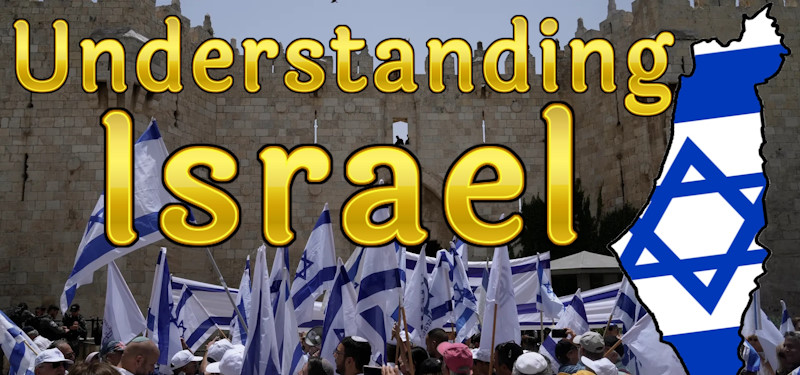
The intense pressure and animosity directed toward Israel, a relatively small nation in the Middle East, often appears disproportionate and illogical from a secular viewpoint.
Similarly, the widespread support for Israel's adversaries can seem counterintuitive. To fully understand this, one must adopt a biblical perspective rather than relying solely on worldly wisdom.
Without key insights from Scripture, the underlying forces at play remain obscured.
This global opposition to Israel and Jerusalem was foretold in the Bible, specifically in Zechariah 12:3:
"On that day I will make Jerusalem a burdensome stone for all peoples; all who heave it shall grievously wound themselves. And all the nations of the earth shall come together against it."
This prophecy raises a fundamental question: Why would the nations of the world unite against Jerusalem?
The reestablishment of Israel as a nation in 1948 aligns with the prophecy in Ezekiel 37:10-12, which describes a miraculous revival:
10 So I prophesied as he commanded me, and the breath came into them, and they lived and stood on their feet, an exceedingly great army.
11 Then he said to me, “Son of man, these bones are the whole house of Israel. Behold, they say, ‘Our bones are dried up, and our hope is lost; we are indeed cut off.’
12 Therefore prophesy, and say to them, Thus says the Lord God: Behold, I will open your graves and raise you from your graves, O my people. And I will bring you into the land of Israel.
Notably, this passage depicts the restored Israel not merely as a nation but as "an exceedingly great army."
While the Israel Defense Forces (IDF) are indeed advanced and have achieved victories against overwhelming odds, the deeper significance lies in Israel's role in a larger spiritual narrative.
This raises further questions: Why does such a small country require such formidable military strength, and what enables its repeated successes?
The answers are illuminated in Revelation 12:7-9, which describes a cosmic conflict:
"And war broke out in heaven: Michael and his angels fought with the dragon. And the dragon and his angels fought, but they did not prevail, nor was a place found for them in heaven any longer. So the great dragon was cast out, that serpent of old, called the devil and satan, who deceives the whole world; he was cast to the earth, and his angels were cast out with him."
This passage portrays satan (the dragon) being expelled from heaven to earth, setting the stage for earthly battles.
Jesus Himself underscores Israel's pivotal role in John 4:22:
"You worship what you do not know; we know what we worship, for salvation is of the Jews."
Who, then, is Michael in this context? Daniel 12:1 provides clarity:
"At that time Michael shall stand up, the great prince who stands watch over the sons of your people; and there shall be a time of trouble, such as never was since there was a nation, even to that time. And at that time your people shall be delivered, everyone who is found written in the book."
Here, Michael is depicted as the archangel who protects Israel during an unprecedented period of distress, leading to deliverance for God's people.
These scriptures point to Israel's role in the end times as a key arena for the ultimate defeat of satan—described as the ancient serpent and the deceiver of the entire world. It's easy to view the conflicts surrounding Israel as just another set of political or territorial struggles, but from a biblical standpoint, they're tied to something far more profound: the complete dismantling of evil forces and the pathway to redemption and hope for all humanity.
You may think the fight against Israel is for some lesser issue, but it's for the MOST important issue of all time: The Destruction of satan and his forces, and the Redemption of all mankind.